Welcome to our used car market research resource for Hinsdale County, Colorado. If you are comparing prices, gauging demand, or choosing the right vehicle for mountain living in and around Lake City, this page brings together practical local insights and data driven tips. We outline how inventory turns, seasonality, and road conditions can influence pricing and value, and we show you how to evaluate vehicle history, ownership costs, and inspection points that matter in high altitude terrain.
Use this guide to understand which models tend to hold value in Western Slope counties, how mileage and maintenance influence pricing in alpine climates, and how to build a smart budget that factors insurance, fuel, and service. When you are ready to compare options, browse our used inventory, review sold vehicles for historical benchmarks, or visit our blog for deeper buyer education. Everything below is tailored to shoppers researching used cars in Hinsdale County.
Below you will find a detailed framework for evaluating the Hinsdale County used car market. We cover price trends, vehicle types that suit mountain roads, inspection checklists for Colorado conditions, and budgeting considerations. You can also explore related research pages for nearby counties and financing resources, plus quick links to learn more about our dealership and policies.
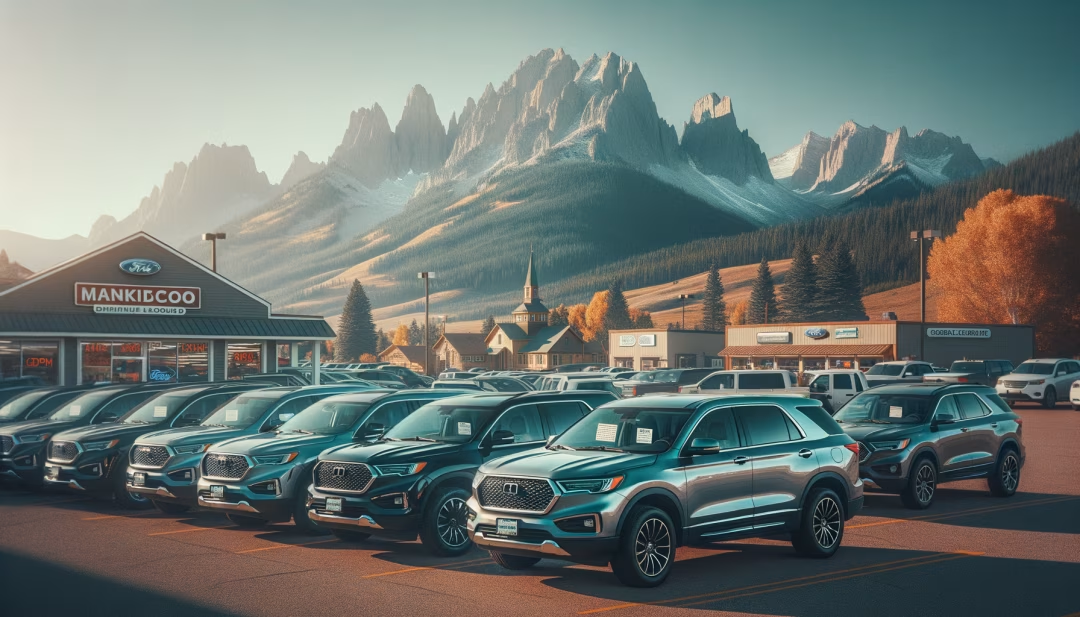
Hinsdale County is a rural, high altitude market where inventory availability, seasonal access, and weather can create meaningful swings in pricing and demand. Buyers commonly prioritize all wheel drive and four wheel drive for year round confidence, along with higher ground clearance and reliable heating and cooling systems. Trucks, crossovers, and midsize SUVs typically see steady interest, especially models known for durable drivetrains and manageable maintenance costs. Because fewer units circulate locally compared to urban counties, shoppers often expand their search radius to nearby regions, then compare pricing and condition. That is why understanding regional trends, transport costs, and seasonal timing can help you secure a better value.
Focus on traction, braking, stability, and clearance. Look for vehicles that offer selectable drive modes or locking differentials for rough roads. Evaluate tire life and the rating of the current set. Consider heater performance and defrost speed. If you plan to tow or haul gear, confirm payload and tow ratings relative to your cargo and elevation. Finally, check for cooling system service and battery condition because altitude and temperature swings can stress components.
To validate a fair deal, compare similar vehicles by year, trim, drivetrain, mileage band, and condition. Cross reference current availability and recently sold vehicles to see how prices behaved for comparable units. Our Sold Inventory can help identify real world benchmarks. Adjust for condition differences, equipment packages, and reconditioning performed. If a unit includes new tires, recent brakes, or major fluid services, that value should be reflected in your comparison.
Vehicle budgets should account for the total cost of ownership, not just the purchase price. At elevation and with variable road conditions, you may see higher wear on tires, brakes, and suspension. Fuel economy can dip in cold weather, and insurance rates vary by garaging location and usage. Build a realistic plan that includes an inspection reserve and a set aside for tires or snow rated replacements if your vehicle does not already have them.
Before committing, compare terms from multiple lenders and understand how down payment and term length affect total interest. A shorter term with a slightly higher payment can reduce total cost significantly. If your credit profile needs work, explore our second chance education resources. Even small improvements in credit or a slightly larger down payment may qualify you for better terms. For additional reading, see financing resources such as Used Car Financing Denver CO, Used Car Financing Mesa CO, and Second Chance Auto Financing Denver CO.
A cleaner, well documented trade in can return more. Gather service records, remove personal items, and address inexpensive cosmetic fixes ahead of time. Present both factory keys and accessories like cargo covers or bed liners. If your vehicle has new tires, recent brakes, or a fresh battery, make that clear. Review our Blog for additional trade in guidance and recent market topics.
A vehicle history report helps verify ownership changes, title status, and mileage consistency. Pair it with a thorough in person inspection or a trusted technician review. In mountain regions, underbody inspection is essential. Look for signs of corrosion or damage, check the exhaust hangers, and confirm the condition of brake and fuel lines. Ensure that HVAC, heated seats, defrosters, and remote start functions (if equipped) work as expected in cold weather.
Buyers in Hinsdale often focus on practical versatility. Compact SUVs blend fuel economy with all weather traction. Midsize and full size SUVs provide space for gear and family trips along scenic byways. Half ton pickups are popular for hauling and trailhead access, while certain wagons and crossovers with all wheel drive offer car like handling plus winter capability. When evaluating engine options, balance power for elevation with fuel costs and maintenance complexity.
Start with our Used Inventory to shortlist vehicles that match your drivetrain, budget, and size requirements. Review our Sold Inventory for price and equipment context. Visit About Us to learn how we source, inspect, and recondition vehicles. If you have questions about a specific model or policy, see Visitor Agreement and Privacy Policy, or reach us through Contact Us.
Market dynamics differ by county. Compare trends across nearby regions to understand supply and pricing movements that can affect Hinsdale shoppers.
When you line up vehicles side by side, focus on attributes that most strongly move the price. These usually include age, mileage band, drivetrain, trim level and packages, tire condition, accident history, and reconditioning. Avoid assuming that a single feature can explain a large price delta without considering trim content or condition. For example, two SUVs may look similar, but one might include upgraded safety tech, a tow package, and a new set of snow rated tires. Document those differences and assign a reasonable value range to each item. If a vehicle includes fresh service worth several hundred dollars, that helps justify a slightly higher price compared to a unit that will immediately need maintenance.
AWD or 4WD availability, documented maintenance, tire and brake condition, accident history, and seasonality are the main drivers. As winter nears, demand for traction equipped models rises, which can narrow selection and raise prices for the most capable configurations.
Late spring and midsummer can offer more selection before pre winter demand tightens supply for AWD and 4WD. However, you can still find value any time by comparing nearby counties, verifying condition, and recognizing reconditioning value like new tires or recent brakes.
Check title status, mileage consistency, service entries, and any structural or airbag records. Use the report to guide an inspection. If the report shows regular maintenance and no major damage events, that supports stronger confidence. Always confirm with an in person inspection and road test.
Evaluate uphill power, downhill braking confidence, steering feel, alignment on straight sections, transmission shift quality, and AWD or 4WD engagement. Test defrost and heating performance. Listen for drivetrain or suspension noises over uneven surfaces and check for vibration at highway speeds.
Stabilize income documentation, reduce credit utilization, correct any report inaccuracies, and consider a larger down payment. A cosigner with strong credit may help. Learn more in our financing education, including pages like Second Chance Auto Financing Denver CO.